


There is a kind of heaviness many women carry that doesn’t have a clear beginning or a visible reason. It doesn’t arrive suddenly; it slowly settles into everyday life, layer by layer, through responsibilities, expectations, and emotions that are rarely spoken out loud.
Most women keep going. They manage work, family, relationships, and countless small tasks that never seem to end. From the outside, everything may look fine. But inside, there is often a quiet exhaustion that words cannot fully explain.
It’s not always sadness. Sometimes it’s just feeling “full” in the mind, like there is no space left to breathe or pause properly. A constant sense of being responsible for everything, even when no one asks for it directly.
This silent pressure builds over time. Not in dramatic moments, but in ordinary days that repeat again and again until emotional fatigue starts to feel like normal life.

Why This Topic Feels So Real in Everyday Life
Most women don’t wake up one day and suddenly feel mentally exhausted. It builds quietly.
Not through one big event, but through hundreds of small moments that never really stop answering everyone, managing everything, remembering everything, and still trying to stay “okay” in front of the world. On the outside, life keeps moving normally. Work gets done, the family is managed, conversations happen, and smiles are shared. But inside, many women are carrying emotional overload that no one can really see. That is what makes women’s mental health so important to talk about, not because it is rare, but because it is often invisible.
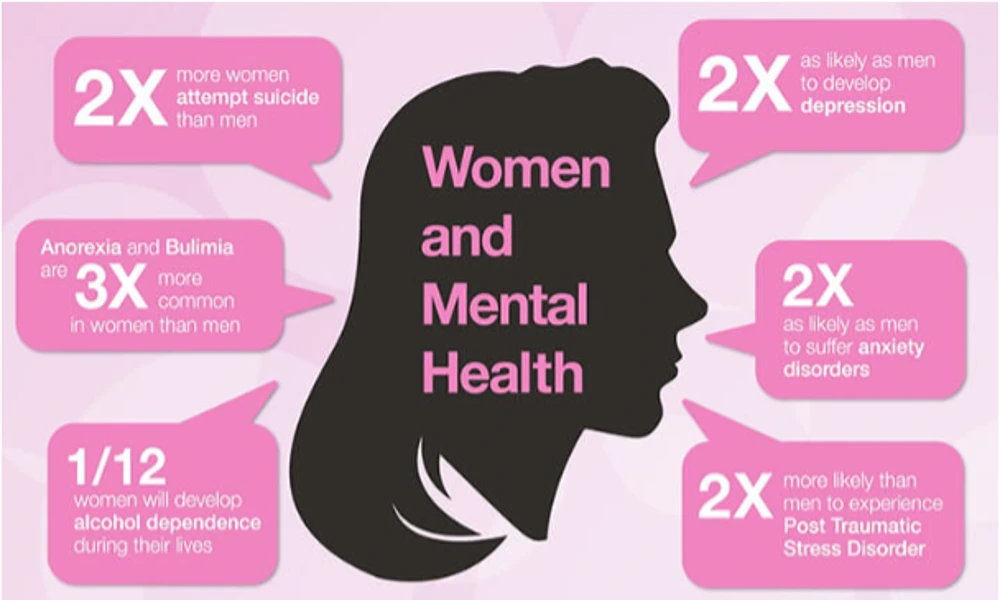
The World Health Organization has highlighted that women are more likely to experience anxiety and depression than men. This is influenced not only by biological factors but also by long-term stress, caregiving responsibilities, and social pressure. And the most difficult part is that this reality is often missed in everyday conversations.
The Mental Load That Never Really Ends
There is a kind of tiredness that doesn’t come from physical work alone. It comes from constantly thinking.
What needs to be done.
Who needs what?
What might go wrong?
What was forgotten.
This ongoing mental responsibility quietly shapes mental health in women over time. Even when a woman is resting, her mind is usually not.
It keeps running in the background like a machine that never switches off.
And the difficult part is that this is often not recognized as “work.” It is just expected. So it doesn’t get acknowledged, even though it takes a real emotional toll. Slowly, it turns into exhaustion that feels normal.
Anxiety That Lives Behind Everyday Functioning
Anxiety is not always visible.
In many women, it doesn’t look like panic or breakdowns. It looks like overthinking small things. Replaying conversations. Preparing for worst-case scenarios that may never happen. Feeling uneasy even when everything is fine.
This is how anxiety in women often exists in real life: quiet, constant, and hidden behind normal routines.
Many women don’t even call it anxiety. They call it “just thinking too much” or “being responsible.”
But when the mind never really relaxes, it slowly drains emotional energy.
And after a point, even simple tasks start feeling heavier than they should.
Depression That Doesn’t Always Look Like Sadness
Visible sadness is not depression; we often associate it with depression, but in reality, depression is persistent sadness, which doesn’t let anyone focus on routine chores. Depression may occur without a specific trigger. It often involves feelings of numbness, worthlessness, and guilt. It’s the result of a complex mix of environment and biology.
In many women, depression looks more like emotional distance than crying. You feel continuous life on the outside, but a sense of disconnection from the inside. You feel like motivation drops, and you lose interest in pleasing things. That is important because it removes the idea that it is simply “just a phase” or “just emotions.”It is more complex than that.
Hormones Matter, But They Don’t Explain Everything
Hormonal changes affect a woman’s emotional well-being more than the discussion.
Puberty, menstrual cycles, pregnancy, postpartum recovery, and menopause all bring shifts in mood and energy.But the problem starts when everything gets reduced to just hormones. Because most women are not only dealing with biological changes. They are also dealing with responsibilities, stress, expectations, and emotional pressure that continues alongside everything else.
The National Institute of Mental Health also points out that women’s mental health is influenced by both biological transitions and life stressors together, not separately.
So the reality is layered.
Not simple.
Motherhood: Meaningful, But Mentally Heavy
Motherhood is often seen as something purely beautiful. When a woman enters the era where she becomes a mother, she feels a lot of peace and wants to take care of her child. She feels like a heavenly abode. But at the same time, she suffers a lot from compromising these elements, which takes her toward women’s psychological health.
- Sleep disruption.
- Constant responsibility.
- Physical recovery.
- Identity changes.
- Emotional pressure to always be “okay.”
According to the World Health Organization, most of the women experience depression after childbirth.
But they don’t talk to anyone because of the family or society pressure to be a strong or grateful mother, and at this time, this pressure turns into postpartum depression symptoms.
As a mother, you would be aware of your health concerns. You should get your proper sleep, or you will not live a healthy lifestyle. That doesn’t make motherhood less meaningful.
It just makes it human.
Stress That Slowly Becomes a Way of Living
One of the biggest issues in women’s mental health is how easily stress becomes normal.
A woman doesn’t always realize she is overwhelmed because she has been functioning in that state for so long.
- Work pressure.
- Home responsibilities.
- Emotional availability.
- Social expectations.
It all blends into daily life. This constant pressure affects stress management for women, not because women are incapable, but because the load is often too much for too long.
Burnout doesn’t usually happen suddenly. It builds quietly over time until even small things feel draining.
Comparison That Slowly Affects Self-Worth
Social media has made comparison almost automatic.
Everyone seems more successful. More organized. More confident. More “together.”Even when people know it is not real life, it still affects how they feel.
This has a direct impact on self-esteem in women, because self-worth begins to feel measured against external images instead of personal reality.
And the problem is not just comparison itself, it’s repetition. Seeing the same pressure daily slowly shifts how women view their own lives. As a woman, you must understand who you are. And what is your worth? Don’t try to chase the lies around you. Recognize your presence in your society, not in Social media.
What Real Support Actually Means
Improving women’s mental health is not about motivational talk or quick advice.
It is about reducing the pressure that builds up in everyday life.
Real support can be to give proper space to the women involved in your life; she could be your partner, your mother, sister, or anyone in your workplace. Just simply try to reduce the pressure and make her comfortable in her daily routine. These mentioned things can work like magic to improve the emotional health of women.
- Getting proper sleep.
- Talking to someone trusted.
- Therapy.
- Medical support.
- Setting boundaries.
- Taking breaks without guilt.
- Learning that rest is not laziness.
Healing can also mean recognizing that constantly carrying everything alone should not be the standard.
A 2023 Harvard Health review also emphasized that women’s mental well-being is often influenced by the combined effects of social roles, biology, and chronic stress, not one isolated cause.
Which means real care must also be holistic.
Final Thoughts
Most women are not struggling because they are incapable.
They are struggling because they are carrying too much for too long without enough space to pause. And when that becomes normal, it becomes invisible. That is why women’s mental health is not just another topic. It is real life. And maybe the most important shift is simple: Instead of expecting women to handle everything better…We should also start questioning why they are expected to carry so much in the first place. As a family, as a colleague, or as a partner, the goal should not just be teaching women how to manage more pressure. Maybe it should also be creating lives, families, workplaces, and expectations that place less pressure on them to begin with. Because she deserves support while living it. If a woman suffers from depression or anxiety for a couple of weeks, she must seek professional mental health help.
FAQs
1. What is women’s mental health?
Women’s mental health refers to the emotional, psychological, and social well-being of women, including how they think, feel, and handle stress, relationships, and life challenges.
2. Why is mental health more common in women?
According to the World Health Organization (WHO), women are more likely to experience anxiety and depression due to a combination of hormonal changes, social pressure, caregiving roles, and life stress.
3. What are common mental health issues in women?
Common issues include anxiety disorders, depression, postpartum depression, stress-related burnout, and emotional exhaustion.
4. How do hormones affect women’s mental health?
Hormonal changes during menstruation, pregnancy, postpartum, and menopause can influence mood, stress levels, and emotional stability in women.
5. What are the early signs of mental health problems in women?
Early signs include constant fatigue, overthinking, mood swings, loss of interest, emotional numbness, sleep problems, and irritability.
6. What is postpartum depression?
Postpartum depression is a mental health condition some women experience after childbirth, involving sadness, anxiety, fatigue, and emotional instability. The NIMH notes it can affect a significant number of new mothers.
7. How can women improve their mental health?
Improving mental health may include therapy, proper sleep, stress management, setting boundaries, emotional support, and healthy lifestyle habits.